
Paul.....staring eye to eye with a chicken....MARY. Paul lost....the hen had her head in that bowl of cat food and Paul soon joined her. All three ate the entire bowl of now "Special Kitty Kitten Chow"....not Meow Mix anymore..
This is the only hen that lives in the barn.....she lays "bigger than JUMBO eggs" in Barney, Betty and Barbie's hay manger every single day......
Her black sister hen lives in the hen house with the other chickens.....I fear she will disappear like the Guinea. His feathers were found....no more Guinea hens...
by lat454205/Lisa
Peter, Paul and Mary....the chicken. [Image]
I beg your pardon!

Sjaantje didn't like Foppe's attitude one bit and waggled up to him to teach him a lesson. She didn't get a chance though, Foppe took off as quickly as he could;-)
These ducks are not to mess with;-)
by Mr Moor
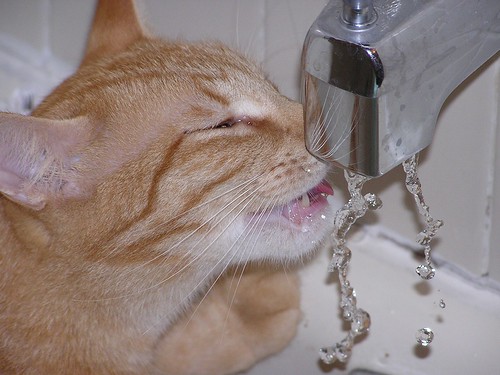
Boog Gets a Drink

"Boog" belongs to Kris and Bill, and his name came from "Big Old Orange Guy". A stray who came to stay. [..]
Bill reports recently that Boog just died, hopefully of natural causes. Boog was a good ole boy and is missed. Bill has got a photo he took of Boog a few months ago, filling up the bathroom sink as his sleeping place. Take a look at it here.
by cobalt123
Mr. Munchkin's Morning Drink. [photo]
Every morning as I get ready, Mr. Munchkin comes in and climbs in the tub, ready for his "fresh" drink of water. He will drink out of the daily-changed bowl but prefers the tub.
He will also sit between the two shower curtains while I shower...
by AJSR Media
How To Feed Your Pet And Keep Away The Vet
 Once-a-day? Twice-a-day? Free-feed? Ask around and you'll hear lots of different opinions on what is the optimal feeding schedule for your cat or dog food. So what is the correct answer? Well first off, rest easy as there is no hard and fast correct answer. That said, however, it's our opinion that free-feeding is the worst way to go.
The best comparison we can make is that free-feeding would be like a person having a full buffet in your house, stocked with food 24 hours-a-day. When you think of it this way, it's not hard to understand why pets that are free-fed tend to be sluggish, lethargic, and passionless about their pet food -- in addition to having a variety of dog health problems. After all, how excited would you be about that lasagna if you had a big bowl of it sitting in the corner all day long. In a dog or cat's life food is the #1 motivation they have. Sure, they love rides in the car, going for a walk, or getting a visit from the neighbor's pet. But nothing beats a great natural dog food. A critter with no passion for food is an unhappy critter. A pet should have a unbridled passion for food. They need to look forward to their next meal with anticipation and excitement. This lays the foundation for a well-tempered, happy pet. In addition the negative effect on disposition, having access to food 24 hours-a-day is not ideal for the digestive system. Dogs and cats in the wild have long breaks between meals -- far longer than humans who operate ideally on 3 meals per day. These breaks give their digestive system a chance to rest and prepare for the next meal. So if this is all true, why do some pet foods suggest free-feeding? For the same reason that your shampoo bottle tells you to lather, rinse, and repeat . . . to sell more shampoo. The sad fact is that many pet food manufacturers are far more concerned with the almighty dollar than the health of your pets.
So now that we've eliminated free-feeding, should you go with once or twice-per-day? (We don't suggest three meals for the same reasons that free-feeding is not ideal). Between once-a-day and twice-a-day, it's really a matter of convenience and preference. If you need a definite answer, we would go with once-per day. This allows for a long period of rest for the digestive system and has shown to produce the best results over the years as far as the health and attitude of the dog or cat. However, once-a-day feeding has proven difficult. Many dogs and cats drive their owners crazy begging for food throughout the day when on a once-a-day diet. Usually this type of behavior can be trained out of the pet of you stick with it for a couple of weeks. But it does take a lot of patience in those cases. That said, twice-a-day does work for many people and they still have very good results -- along with a dog that's not quite so obsessive about food throughout the day. Whether you're trying to achieve once-per-day or twice-per-day feeding, the best way to do it is to be as consistent as possible with your feeding times. Put the pet food down for a specified feeding window and pick it up after around 10 minutes regardless of if they've finished or not. They will quickly conform to this new feeding window. The more you cave in to your pet's demands, the longer it will take them to become accustomed to their new feeding schedule. If you're going to do snacks during the day, we recommend feeding them as rewards only, and to use healthy foods like raw carrots or apples. Also, the more you stick to a routine of specific times and events for reward snacks, the less your dog or cat will beg between meals.
If you're doing twice-per-day feeding we suggest one meal in the morning and one at night. If you're feeding once-per-day, either morning or night will work. Also, keep in mind that these rules do not apply to puppies and kittens, which do need 2-3 smaller meals throughout the day as opposed to once-a-day feeding.
---------------
Ward Johnson
Holistic dog food
photo source

Adopt Me, Please! [photo]
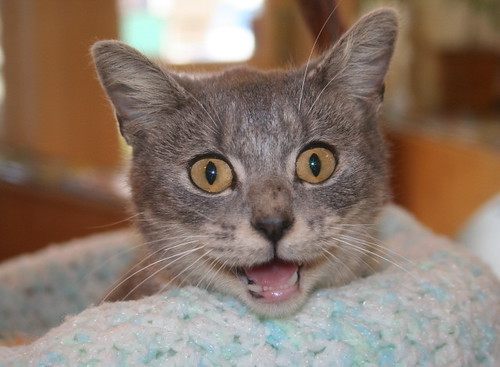
Adopted on NOV 8
My daughter & I rescued this precious kitten in Appling, sick and emaciated...weighed 3 pounds. She is actually 4-6 months old and stunted in her growth.This is the most lovable cat we have ever met. She spent two weeks at the vet hospital regaining her health and was adopted to a wonderful lady as her new companion. You won't find a sweeter kitten anywhere. Located in Evans, Georgia.
by moosmom
What To Do When Your Cat Won't Use The Cat Litter Tray
 The development of the cat litter tray has truly become a milestone for pet ownership. The modern use of cat litter in boxes or trays has allowed the cat owner to easily take care of their cats waste as well as provide a great place for indoor cats to do their business.
But some cats tend not to do their elimination activities at designated places like the cat litter tray. It is important that you observe your pet closely and find out whether the litter tray is being used by the cat.
There are several possible factors that could prevent the cat from opting to use the cat litter tray. For one, cats need ample space to squat, turn around and dig when they do their thing. Thus, if the cat litter tray is too small, the cat may not have enough space to move around. Even you would not be comfortable doing such in a very tightly spaced bathroom, right?
Another factor would be the litter used in the tray. For years, manufacturers have used clay and silica as litter substrates. But lately, experts advise them to refrain from using such materials since cats are not comfortable digging through them.
There are two types of litter trays being sold in the market currently. One is the open-spaced type, and the other is the closed litter box. Based on observations and pet owners' experiences, cats usually prefer the open-type one because it provides ample room for movement. However, most pet owners prefer the closed-type because it hides the waste and keeps the smell from permeating throughout the house.
When buying cat litter trays for the first time, it is recommended that you purchase both types. That way, you can determine which type is preferred by the cat. Remember, it is the cat that would use the litter tray, not you, so respect the animal's preference.
When Your Cat Won't Use The Litter Tray
You could help make the tray be a comfortable place for your cat. For one, strategically place the tray where the cat could easily spot it and have access to it.
Do not place the cat litter tray at hidden areas like under some furniture, at the garage, under the air conditioner, or somewhere else where people could not easily spot the box. Chances are, the cat would also find it hard to find the litter tray, and it could no longer hold its urge before it finds the tray.
Manufacturers also advise that as much as possible, put litter trays in all floors of the house so the cat could easily have access to them once they feel the urge.
Do not put deodorizer or air fresheners on top or beneath the cat litter tray. The cat may not like the smell of the chemicals coming from such fresheners. If you want to make sure no smell would originate from the tray, you could put some baking soda underneath the tray. Baking soda would not be detected by the cat because it does not secrete harsh smell that may annoy the cat's sharp olfactory senses.
Since the cat is also a territorial animal, make sure each cat, if you have several at home, has its own designated cat litter tray. They would not want to share territories.
Buy trays that are using very fine materials, as fine as sand, as litter substrate. As mentioned earlier, silica and clay are not preferred by cats anymore.
If all else fails, your cat must have some sort of behavioral problems. Thus, seek the help of your veterinarian at once.
------------
Lee Dobbins
Cat litter tray
photo source
Fluffy on banister [photo]
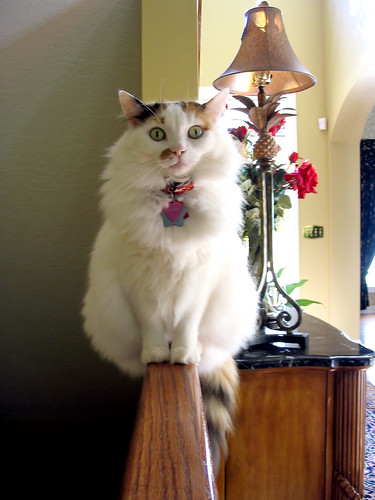
This little devil is Fluffy. She belongs to a family that owns 12 cats... and I'm housesitting for them. They are all rescue animals that have health problems (mostly upper respiratory issues that require medication). Yes, they are all indoor cats. Yes, they have a maid that comes everyday. No, the house doesn't smell like cats (it helps that the place is huge!)
Fluffy is quite, um, fluffy. She also likes to give me the evil eye. The other cats mostly keep their distance, because she's one of the few that isn't declawed and the most likely to smack another cat in the face if she's annoyed with them.
by 'afotographie'
Tips on Cat Urine Removal
 If you have lived for any amount of time with a pet (particularly a cat) you probably know the frustration of finding out that he/she has urinated in or on something they were not supposed to. Cat urine has a truly distinct odor and can ruin carpet and furniture if left untreated for long periods of time. Cat urine removal can sometimes prove to be a difficult task. So what can you do if your cat has urinated anywhere other than the litter box?
Cat Urine Removal Don'ts
Well, first let's discuss some of the myths that are incorrect methods of cat urine removal. Some think that cleaning with any cleaning product will do the trick. They look on the bottle and if it says "all purpose" on it, that will work for anything. This is incorrect. Never ever attempt cat urine removal with a cleaning product that contains ammonia. The reason for this is that cat urine consists of a fairly large amount of ammonia. If a cat smells this ammonia in the carpet they will probably urinate there again.
Pay Attention
If your cat is generally good with going in the litter box and never urinates outside of where they are supposed to and then all of the sudden starts having accidents, the solution to this problem may be as easy as paying attention to your surroundings. Cats often can be negatively affected by their surroundings. It is possible that your cat may be looking outside and becoming stressed by other cats, dogs walking by or maybe some other animals that it sees. What you may want to try to do is block their view from any outside events. Another option may be to keep a close eye on the litter box. Cats are neat freaks so if the litter box is dirty, chances are that they will not want to use it and will attempt to take their business elsewhere if this is the case.
Cat Urine Removal Steps
So if the above tips just simply aren't working and you do find an accident or two, here are a few steps to help you in the cat urine removal process:
Step 1: If you find a wet spot, immediately go and grab some paper towels and cover the affected area. Place the paper towels over top of the area and apply light pressure. Note, if you have a dry stain on your hands and don't know where to locate it, you can turn off your lights and use a black fluorescent light and this will bring out the cat urine stains in the carpet. Dampen the area before you proceed to step 2.
Step 2: Mix up a solution of white vinegar and water in a bucket. One part white vinegar and two parts water should do the trick. Rub the solution in the area with a paper towel or wash cloth.
Step 3: After the area seems to be clean, wipe the area with water using a separate wash cloth. It is recommended that you repeat the cat urine removal process again by rubbing the area with the vinegar water solution and wiping the area with water.
Step 4: If this solution does not work, you may want to consider investing in a product specifically aimed at cat urine removal. Their are many of them on the market today and you should ask your vet which one is right for your particular situation.
Cat urine removal can be a big headache but if you follow these simple steps you should be able to limit some of your stress. Make sure that if the cat urination persists or is out of the ordinary, that you take your pet to the vet to get him/her checked out. The urination may be caused by something medical related and you just don't want to take a chance.
-----------
Helen Croft
Cat Urine Removal
photo source
Yummy yumy [photo]
Another turning point, a fork stuck in the road
Time grabs you by the wrist, directs you where to go
So make the best of this test, and don't ask why
It's not a question, but a lesson learned in time
It's something unpredictable, but in the end it's right.
I hope you had the time of your life.
So take the photographs, and still frames in your mind
Hang it on a shelf in good health and good time
Tattoos of memories and dead skin on trial
For what it's worth it was worth all the while
"Good Riddance (Time of you life)" - Green Day
by pink_daisy
Cat Insurance: Be a caring owner!
 Many households in UK own a cat; in fact UK is considered a nation of pet lovers. But like other animals, a cat can also fall ill or meet with an accident. It is estimated that almost 50% of the cats in UK want a medical treatment of a high cost. Apart from emergencies, a cat needs regular vaccines and routine checkups. But just like the rising cost of medical bills of humans, the cost of cat's treatment is also on a rise. This unexpected medical bill can put a serious dent to your household's monthly budget. Therefore, cat insurance is a must for all cat loving human beings. Apart from its health issues, a cat also can get stolen or lost. And we all know how much does it cost to buy a cat in UK. Obviously we do not want to shell out hundreds of pounds again to buy a cat. Here also, a cat insurance policy can save you from this unexpected loss. All you need to do is to pay a certain amount to the insurance company as premium and the insurance company will provide you with the coverage for your pets.
A cat insurance policy is a necessity because, the government does not provide for health facilities to a cat for free unlike human beings. Therefore by buying cat insurance for your cats you can free yourself and also your cats from any financial constraints.
Cat insurance comes with certain restrictions, like pre-existing health conditions will not be covered by your cat insurance provider. So it is highly recommendable to read and re-read the insurance company's brochure. You should ask the insurance provider if there are some doubts in your mind regarding the amount of coverage. You need to provide to the insurance provider some information about your cat, its age, its breed etc. Apart from that you need to consider certain questions before buying cat insurance, like the rate of premium, amount of deductibles, amount of coverage etc.
With internet facilities you can easily search and locate cat insurance policies. You can compare hundreds of such companies that will provide you with cat insurance and later on you can choose the best policy from among them. Most companies offer discounts if you buy cat insurance from them through the online method. You can easily and conveniently get it delivered to your door steps by applying online. So get a cat insurance now and show that you care for your cats.
------------
Jenny Black
Cat Insurance
photo source

How To Solve Cat House Training Problems
 One of the reasons why it can be difficult to solve any type of cat behavior problem relating to house training/house soiling or litter box avoidance, is because you have to identify the cause.
The most difficult part of solving litter box avoidance problems is figuring out what caused the problem in the first place. Unfortunately, cats are very sensitive to change - and if your cat had been using the litterbox faithfully and then suddenly stopped, something has changed whether you are aware of it or not.
So your goal is to find out what has changed.
Here are a few questions to keep in mind:
The most important thing to consider when you need to figure out what has caused a house soiling problem is: Approximately when did the house soiling begin?
2nd most important: Are you certain it's not a health issue such as an Urinary Tract Infection? (The #1 symptom of an UTI is litter box avoidance)
Here are a few other questions to consider that will help you pinpoint the cause:
Did anything at all change near the time when the behavior started? (Try to think of everything, no matter how unimportant it seems)
Have you recently moved to a new house?
Have you introduced a new cat/dog/ferret/roommate into your house?
Have any of the litter boxes been moved? (Maybe he or she has a favorite box to use and that particular one was moved)
Have you rearranged any of your furniture or added new furniture?
Are you completely positive you know which one of your cats is soiling on the carpet?
If you have multiple cats, are they getting along?
Inter-cat tension is actually a lot harder to spot than most owners realize. Your cats may not be physically fighting with each other, but that doesn't necessarily mean they are getting along. One of your cat's may actually be "silently" intimidating one of the others, but you don't know how to read the signs so you aren't aware of it.
If you know exactly which cat isn't using the litter box, and you know which litter box that cat usually uses, watch to see if any of the other cats tend to spend extra time "hanging out" near that box.
If you have any covered litter boxes, pay close attention to any cats that tend to sit on top of the litter box.
One surefire method of retraining a strong-willed cat is to put the cat in a nearly empty room for a few days, with only a few toys, a scratching post, water, a comfortable bed and a litter box.
When using this technique to house train your cat, make sure you don't allow access to the rest of the house until the cat has been completely retrained and there's no risk of further accidents.
Some people are stunned when they realize just how many things can cause a litter box avoidance problem. What they don't realize is that a cat's bathroom habits are actually a very complicated and delicate piece of a cat's life, and it can be easily disturbed
--------------
Liz Barton
Cat House Training
photo source
Happy Furry Friday!
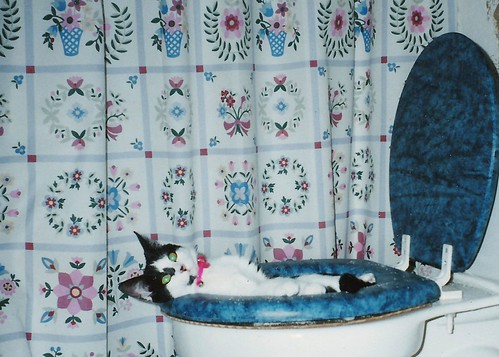
When I first adopted Cory, she was just a kitten and I'd been reading about how you can train your cat to use the toilet. No messy litter boxes, no odor...sounded good to me!
I fashioned a frame out of sturdy cardboard and made a drop-down litter pan (thanks to duct tape, man's best friend). I filled the pan with litter and encouraged Cory to hop in.
Unfortunately, at first, Cory merely thought I went out of my way to make her a really neat place to hang out, as evidenced here.
She eventually caught on and I think she would have taken to the whole idea of using the toilet to do her 'business', if I hadn't gotten too impatient and cut the middle hole too big.
She jumped up one day and splashed right into the water. Needless to say, the experiment ended up in the crapper, so to speak.
by MacaDamien
Subscribe to:
Posts (Atom)